
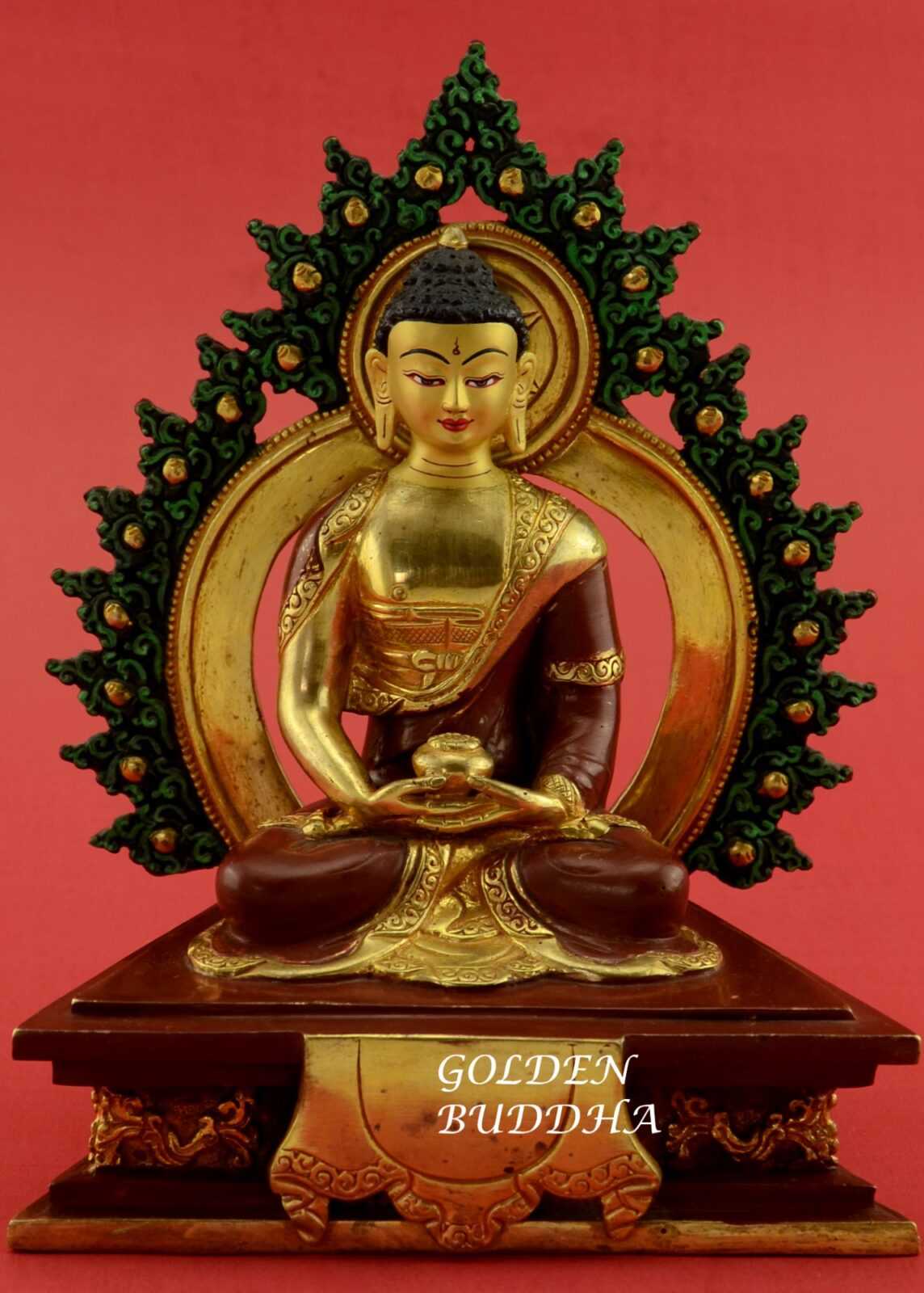


This framed Amitabha statue is depicted in a 24K gold gilded finish wearing a deep red robe — the traditional color associated with Amitabha Buddha’s transformation of desire into discriminating wisdom. The statue was completed using the traditional lost wax sculpting method, and the gold finish was applied using the fire gilding technique, which leaves a genuine 24K gold residue that will not tarnish. The statue is seated in Dhyana Mudra with an alms bowl resting on his right palm.The Dhyana Mudra, or meditation gesture, is used by Buddhist practitioners to represent unwavering, one-pointed concentration. While the alms bowl is not strictly required for this mudra, it is a traditional and common feature on Amitabha statues, symbolizing both his former life as a renunciant monk and the spiritual nourishment he offers to all who call upon him. Full details on Amitabha’s iconography — including the meaning of his mudra, color, and lotus throne — can be found in our guide to Amitabha Statue Iconography: Mudra, Color & Form.Each feature on this piece is rendered with extreme care and detail, and it is rare to find such fine craftsmanship in a small-format statue. Buyers can rest assured they have procured a monastic-quality framed Amitabha statue, hand-carved by Shakya caste artisans in Patan, Nepal. Browse our full range of Amitabha Buddha statues to compare sizes and finishes.The Origins of our Framed Amitabha StatueAmitabha Buddha existed for countless eons as a Bodhisattva named Dharmakara — a great king who renounced his throne to pursue liberation. Dharmakara vowed not to accept Buddhahood until he could guarantee liberation to every being who sincerely called upon him, and he was reincarnated across immeasurable lifetimes to accumulate the merit needed to fulfill that vow. The full story of his path — including his 48 vows — is told in Amitabha’s Long Path to Becoming a Buddha.Having fulfilled his vow, Dharmakara attained Buddhahood as Amitabha and brought into existence his own pure land, called Sukhavati.Amitabha’s Pure Land of SukhavatiThis statue reflects Amitabha’s role as ruler of the Western Pure Land — read the complete account of The Pure Land of Sukhavati, described in Buddhist scripture as a realm of jeweled trees, fragrant lotus ponds, and the continuous sound of Dharma. According to Amitabha’s 18th vow, devotees who recite his name or mantra with sincere faith — a minimum of 10 times — can gain entrance to Sukhavati at the moment of death. Reciting the mantra in front of an Amitabha statue is one of the most traditional methods of Pure Land practice, combining visualization, devotion, and mantra recitation in a single act.Amitabha’s Place in the Buddhist PantheonAmitabha is one of the Five Dhyani Buddhas, presiding over the Western direction and transforming the poison of desire and attachment into discriminating wisdom. He is widely regarded as the most accessible and universally venerated Buddha across Tibetan, Chinese, and Japanese Buddhist traditions. Learn more about his role alongside Shakyamuni, Avalokiteshvara, and the other major figures of the tradition in Amitabha Buddha — Infinite Light and Life, part of our complete guide to the Buddhist pantheon. Certificate of authenticity Authentic, Handmade in Nepal Every statue and ritual item is handcrafted in Patan, Nepal, using traditional lost wax casting and comes with a certificate of authenticity issued by Nepal's Department of Archaeology, verifying its materials, technique, and origin. Learn more about our certification
 No products in the cart.