
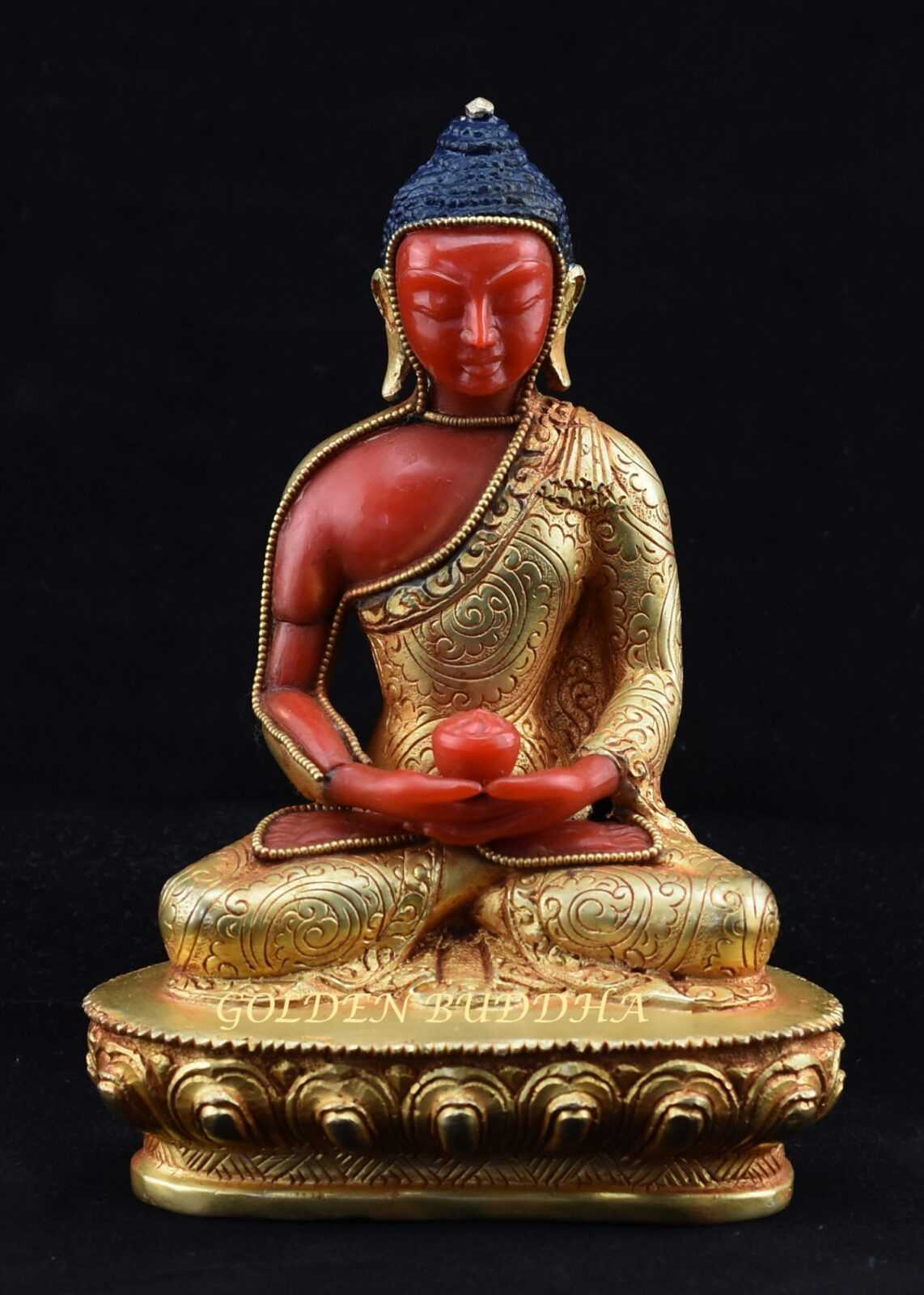


A striking feature of this Amitabha Buddha statue — known in Tibetan as Opame — is the deep red coral paste used to render his face and body, set against a fully gold plated robe and lotus throne. Red is Amitabha’s defining color: meditation on this hue is said to transmute the poison of desire and attachment into the wisdom of discernment. The statue also displays the ushnisha, the cranial protuberance found among the 32 major marks of a fully enlightened Buddha, representing his supreme wisdom and spiritual attainment.The statue portrays the Dhyana Mudra, or meditation gesture, with both hands resting in the lap, palms facing upward, and the alms bowl of a Buddhist monk resting in the palm of the right hand. This mudra represents the unwavering, one-pointed concentration from which enlightened insight arises — a form of wisdom that Buddhist teaching holds can only be cultivated through sustained meditation practice, not through intellectual study alone. For a full breakdown of what each element of this pose represents, see Amitabha Statue Iconography: Mudra, Color & Form.Amitabha’s Pure Land of SukhavatiThis statue depicts one of the most widely venerated Buddhas across Tibetan, Chinese, and Japanese Buddhist traditions. As the Bodhisattva Dharmakara, Amitabha accumulated an inconceivable store of merit across countless lifetimes before attaining Buddhahood — which is why he is known as the Buddha of Infinite Light and Life. The full account of his path to enlightenment is told in Amitabha’s Long Path to Becoming a Buddha.Pure Land Buddhists teach that Amitabha presides over Sukhavati, the Western Pure Land — a realm described in scripture as filled with jeweled trees, fragrant lotus ponds, and the continuous sound of Dharma. Amitabha vowed not to accept Buddhahood until he could guarantee entry into his pure land to any being who sincerely called upon him, and he will admit anyone who recites his name or mantra with sincere faith.Our Amitabha statue sits in full lotus pose on a single lotus pedestal, holding his alms bowl in the Dhyana Mudra. Amitabha is also one of the Five Dhyani Buddhas presiding over the Western direction — see his full role among the Buddhas and Bodhisattvas in Amitabha Buddha — Infinite Light and Life, part of our guide to the Buddhist pantheon. Browse the complete range of Amitabha Buddha statues to compare sizes and finishes. Certificate of authenticity Authentic, Handmade in Nepal Every statue and ritual item is handcrafted in Patan, Nepal, using traditional lost wax casting and comes with a certificate of authenticity issued by Nepal's Department of Archaeology, verifying its materials, technique, and origin. Learn more about our certification
 No products in the cart.